Detection engineering
Detection Validation Pipeline
A detection-as-code pipeline. Every Sigma or KQL rule has to catch a real attack test and stay quiet on normal activity before it can merge, and the results are checked again on real Windows logs and a real Elasticsearch.
- Role
- Solo project
- When
- November 2026
- Status
- Working, with a public dashboard rebuilt from every run
- Built with
- Python, Sigma, KQL, Sysmon, Docker, Elasticsearch, GitHub Actions
- Links
- Dashboard ↗ · GitHub ↗ · A green run ↗
Why I built it
Security teams catch attackers by writing detection rules: small queries that look for suspicious behavior in logs, like PowerShell being launched with an encoded command. Plenty of teams now keep those rules in Git and review them like code. But the usual automated check only confirms that a rule parses.
A rule can parse perfectly and still be useless. It might miss the abbreviated -e flag attackers actually type, or fire every time an admin script sets -ExecutionPolicy. Neither problem shows up until the rule is in production, either silently missing attacks or flooding analysts with noise.
I wanted a pipeline that answers the question a reviewer actually has on a pull request: does this rule catch the attack, and does it stay quiet otherwise?
How it works
When a pull request adds or changes a rule, CI figures out which rules changed and starts one isolated job per rule. Each job runs in its own Docker network with no internet access.
- A simulator generates telemetry modeled on the rule’s mapped Atomic Red Team test, plus a baseline of normal activity.
- A shipper loads the rule into a mock SIEM and sends it the events.
- A validator waits until it can confirm the events arrived, then checks the alerts and returns an exit code.
A rule passes only if three things are true for that run: it’s tagged with the same ATT&CK technique its test exercises, it fires on the attack, and it doesn’t fire on the normal baseline. Here’s what that looks like for a real rule and for the test fixtures I wrote to make sure the validator can say no:
The rule fires on the attack and stays quiet on normal activity.
- Telemetry arrivedAttack and benign events confirmedpass
- Technique mappingTest exercises T1059.001; rule declares T1059.001pass
- True positiveAlert on the attack eventspass
- No false positiveNo alert on the benign baselinepass
PASS · exit 0 · merge allowed
A negative control that misses the attack. The rule author has to act.
- Telemetry arrivedpass
- Technique mappingpass
- True positiveNo alert on the attack eventsfail
- No false positivepass
FAIL · exit 1 · fix the rule
A negative control that also fires on normal admin activity.
- Telemetry arrivedpass
- Technique mappingT1059.001pass
- True positive1 alert on 2 attack eventspass
- No false positive1 alert on 4 benign events: powershell.exe -ExecutionPolicy RemoteSigned -File C:\Ops\inventory.ps1fail
FAIL · exit 1 · fix the rule
Zero alerts means nothing if zero events arrived, so the pipeline refuses to give a verdict.
- Telemetry arrivedNo events confirmed, so there is no trustworthy verdictfail
- Technique mappingskipped
- True positiveskipped
- No false positiveskipped
ERROR · exit 2 · fix the pipeline
Based on the repository’s validator and its negative-control fixtures.
This is the actual output for the “too broad” fixture:
Rule: Negative control: too broad (00000000-0000-4000-8000-000000000002)
Test: T1059.001 PowerShell Command Execution (a538de64-1c74-46ed-aa60-b995ed302598)
  [PASS] Technique mapping: test exercises T1059.001; rule declares ['T1059.001']
  [PASS] True positive: 1 alert(s) on 2 attack event(s) from 'PowerShell Command Execution'
  [FAIL] No false positive: 1 alert(s) on 4 benign event(s)
      matched: powershell.exe -ExecutionPolicy RemoteSigned -File C:\Ops\inventory.ps1
RESULT: FAIL
Three exit codes instead of two
Pass and fail aren’t enough on their own, because “zero alerts” can mean two very different things. Either the rule is too narrow, or the logs never arrived. If a SIEM outage shows up as a failed rule, people learn to ignore the check.
So there are three outcomes. 0 means pass. 1 means the rule is wrong and its author needs to fix it. 2 means there’s no trustworthy verdict, for example missing telemetry, a SIEM that’s down, or a rule using syntax my engine doesn’t support. That last case matters. When the engine hits a clause it can’t evaluate, it returns an error instead of skipping the clause, because skipping part of a rule changes what it means and could produce a false pass.
Simulated logs on PRs, real attacks after merge
Simulated telemetry is fast and harmless, so it can gate every pull request. But simulation can’t prove that Windows actually logs what I modeled.
A second workflow runs the real Atomic tests on a disposable Windows VM with Sysmon, collects the logs, and scores every rule against them. It only runs on pushes to main and manual runs, never on pull requests, because code from a pull request should never get to choose what executes on a machine.
Real machines are noisy, and helper processes often log before the attack does. Instead of labeling events by time window, I label them by process tree: only the process running the test’s command and its children count as attack events.
Real logs corrected my simulation at least once. Exported Sysmon data showed %VAR% written as %%VAR%% inside a command line, so I updated the simulated events to match.
The rules
To give the project a focus, I wrote most of the rules for video-game tampering: license bypass, mod or crack injection, memory tampering, bootleg copies, and license-key abuse. They protect FakeQuest, a harmless stand-in game with a pretend license check that I wrote for this, so nothing touches a real game, real cracks, or real anti-cheat software. The license domain uses the reserved .invalid name, and the “memory tool” closes its handle without reading or writing anything.
| Rule | ATT&CK | Reads | Agrees with Elasticsearch |
|---|---|---|---|
| PowerShell launched with encoded command (Defender XDR) | T1059.001 | Process creation | Not compared (KQL) |
| PowerShell launched with encoded command | T1059.001 | Process creation | 12 of 13 |
| PowerShell launched with short encoded flag | T1059.001 | Process creation | 13 of 13 |
| Command shell obfuscated with variable substring | T1059.003 | Process creation | 13 of 13 |
| License server redirected through the hosts file | T1565.001 | Process creation | 15 of 15 |
| Game loaded a system DLL from outside the Windows folder | T1574.001 | DLL load | 14 of 15 |
| Process requested write access to game memory | T1055 | Process access | 15 of 15 |
| Game running from an unofficial build | T1554 | Process creation | 14 of 14 |
| License key guessing from one address | T1110 | License server log | 15 of 15 |
| One license key on too many machines | T1078 | License server log | 14 of 14 |
The two license-abuse rules count activity over time using standard Sigma correlations. They count different values, not attempts. A player retrying the same mistyped key shouldn’t look like someone guessing 20 different keys. I included two negative controls that count attempts instead, and the pipeline fails both of them on normal players.
Measuring what gets past
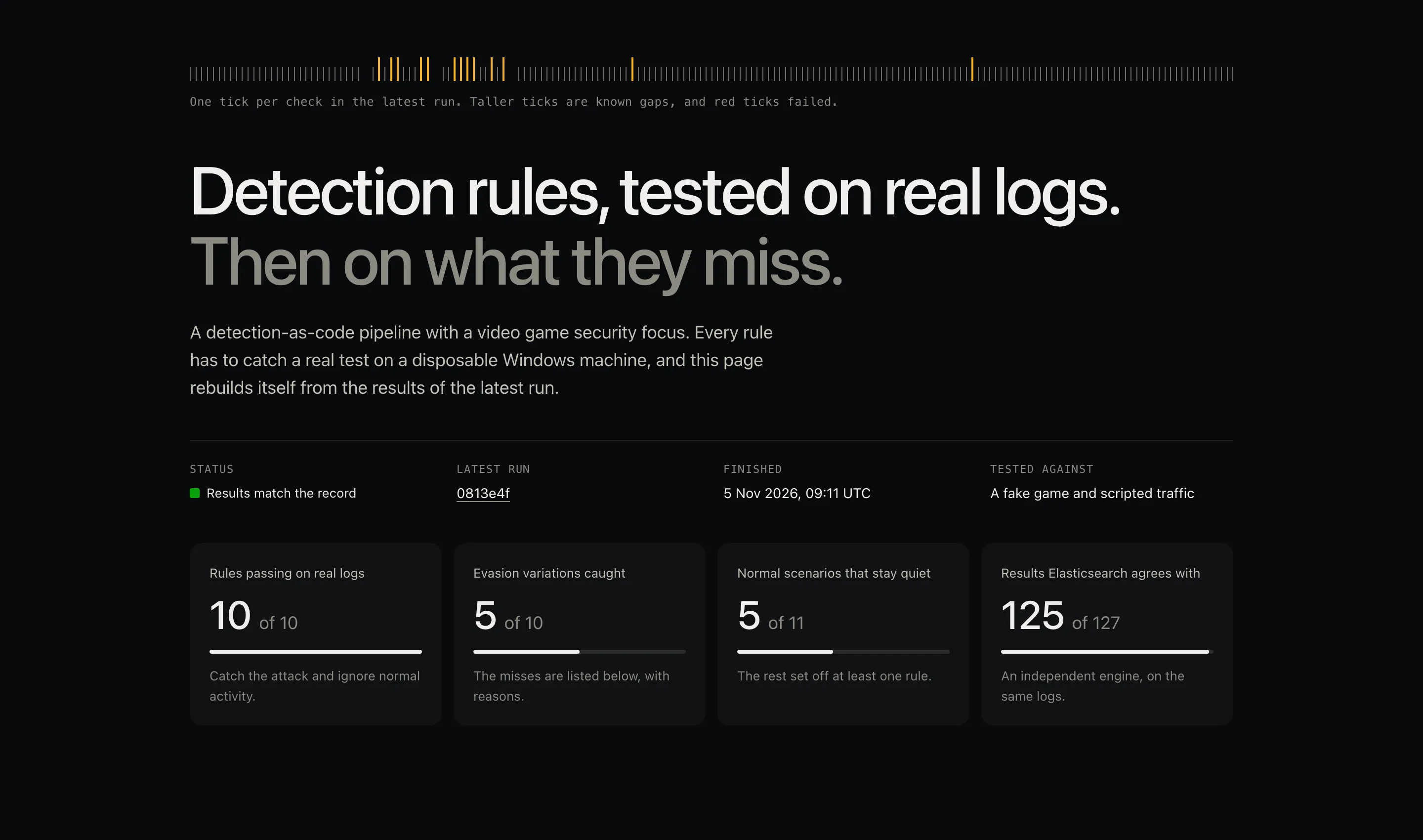
Passing against one version of an attack doesn’t say much about the next one. I wrote ten harmless variations of the game and license attacks and recorded what each rule does with them. On real logs, the rules originally caught 2 of 10. After the fixes they catch 5 of 10.
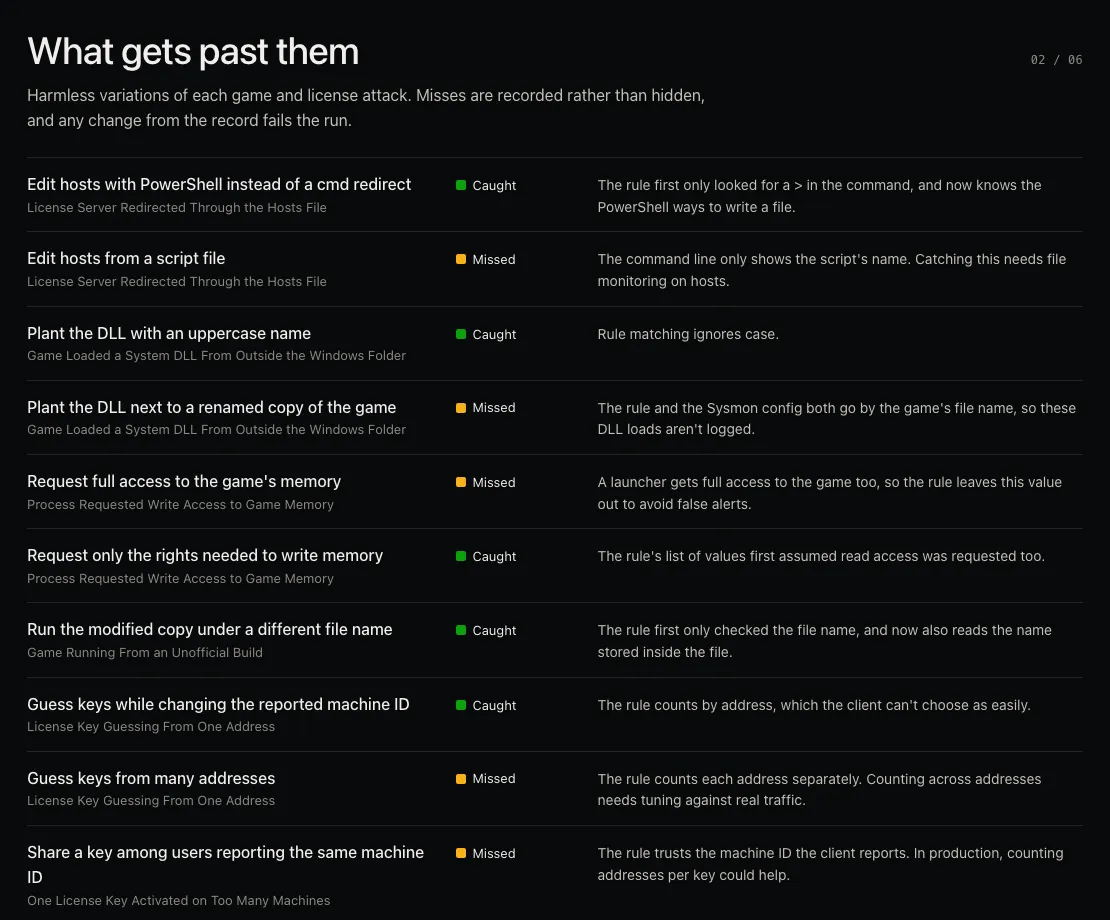
| Variation | Before | Now | What changed or why not |
|---|---|---|---|
Edit hosts file with PowerShell’s Add-Content |
Missed | Caught | The rule now knows PowerShell’s file-writing commands |
| Edit hosts file from a script | Missed | Missed | The command line only shows the script name; needs file monitoring |
Plant the DLL as uppercase WINMM.DLL |
Caught | Caught | Matching ignores case |
| Plant the DLL next to a renamed game | Missed | Missed | Logging every DLL load is too noisy, so logging keys off the game’s name |
| Request full access to game memory | Missed | Missed | Launchers request full access too, so it’s left out on purpose |
| Request write-only access to game memory | Missed | Caught | The rule now covers write access without read access |
| Run the bootleg copy under a new file name | Missed | Caught | The rule now reads the name stored inside the file |
| Guess keys while changing the machine ID | Caught | Caught | The rule counts by address |
| Guess keys from many addresses | Missed | Missed | Needs thresholds tuned on real traffic |
| Share a key while reporting the same machine ID | Missed | Missed | The rule trusts the ID the client reports |
Any result that differs from the record fails the run in either direction. That way known gaps can stay on record without blocking every build, but a regression still fails, and an improvement forces me to update the record.
I did the same for false alarms. Eleven normal scenarios, like a family sharing a PC or a launch day with 60 players, are scored against every rule. Before tuning, 4 of 11 set off no rules. After raising the key-guessing threshold from 10 different keys to 20, a small LAN event with 12 typos stopped triggering it, and 5 of 11 are clean. The cost is that a real guesser now gets 19 tries before an alert instead of 9. The remaining false alarms each have a reason: an official update that isn’t on the hash list yet looks like a bootleg, and a legitimate mod loads the same way a crack does.
Checking my own engine
Every rule passes or fails on engines I wrote, so a pass could mean the engine and the rule share the same misunderstanding. To check that, each real run loads its logs into an actual Elasticsearch instance, converts the Sigma rules with the standard pySigma converter, and compares the results.
125 of 127 results agree. The comparison also turned up problems I never would have found testing against my own engine:
- The converted queries are case-sensitive, even though Sigma rules are supposed to ignore case. In Elasticsearch, two rules miss an uppercase
WINMM.DLLand PowerShell’s-EncodedCommand. Those are the two recorded differences. - The converter’s
likepatterns are rejected outright when a rule contains a Windows path with backslashes. - Its
rlikepatterns have to match the entire value and turn\dinto a literald, so the obfuscation rule never fired at all.
My comparison script corrects the last two. These findings apply to pySigma-backend-elasticsearch 1.1.6, the version I tested.
Treating the rule as untrusted
The repository is public, so anyone can open a pull request containing a rule. I treated every rule as untrusted input. Workflows have read-only permissions and use pull_request rather than pull_request_target, so forks never see secrets. Actions are pinned to full commit SHAs. YAML is only loaded with safe_load. Test containers run as a non-root user with a read-only filesystem, all Linux capabilities dropped, memory and process limits, and no network. Values reach the shell through environment variables instead of inline template expressions, which blocks script injection through file names.
Timeline
Most of it landed over two days, through ten pull requests.
| Date | What landed |
|---|---|
| Nov 4 | Pipeline, first PowerShell rules, and the overbroad-rule demo |
| Nov 4 | Real Windows logs from a disposable VM |
| Nov 4 | Game tampering rules, license-abuse correlations, bootleg-copy detection |
| Nov 4 | Evasion scorecard |
| Nov 5 | Noise scoring across eleven normal scenarios |
| Nov 5 | Elasticsearch comparison |
| Nov 5 | Public dashboard rebuilt from each run |
What it doesn’t prove
- Coverage is small: two Atomic tests, four game tests, and two license tests.
- A real pass covers one clean Windows Server VM with a minimal Sysmon config. It says nothing about false positives on real user activity.
- License traffic is scripted from one machine, so every request has the same address. Real thresholds would need real player traffic.
- Converted rules can behave differently in a real SIEM, as the Elasticsearch comparison shows, so they need testing wherever they run.
- Half the evasion variations still get through.
What I’d do next
The gaps point to the next steps: file monitoring for hosts-file edits made from scripts, signature checks so legitimate overlays stop tripping the memory rule, an approved-mods list, and thresholds tuned against real traffic instead of scripts.
Next KeyGuard